
How it works
Shower Waterproofing Basics
Tile and grout are not waterproof. What keeps water out of your walls and floor is the layer behind them, and it is worth understanding before you hire anyone to build a shower.
How shower waterproofing works
A shower stays dry behind the tile because of a continuous waterproof layer on the walls and floor that directs any water that gets through the grout down to the drain. Tile and cement grout both absorb water. The waterproofing underneath does the real work, and it has to be unbroken: walls lapped over the floor, seams sealed, every pipe and niche detailed, and the whole floor sloped so water can't sit.
There are two broad ways to build that layer. The traditional method uses a liner buried in a mortar bed. The newer method bonds a membrane directly to the surface just under the tile. Both work when done correctly. Most leaks come from how a system was installed, not which one was chosen.
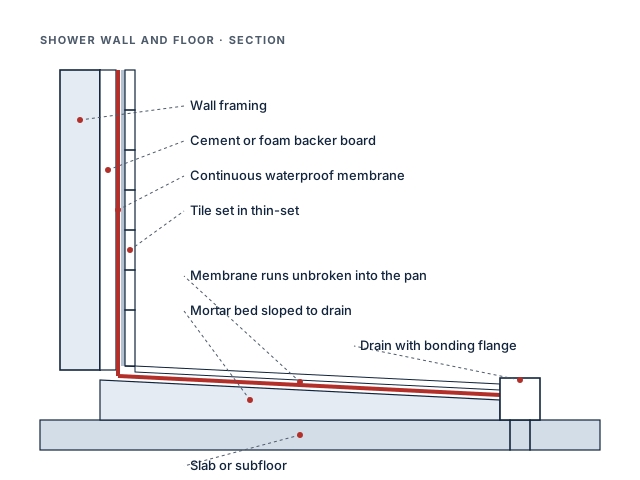
Two ways to build a shower pan
Traditional mortar bed with a liner
This is how showers have been built for generations. A sloped layer of mortar (the pre-slope) goes down first. A flexible waterproof liner sits on top of it, folded into the corners and turned up the walls, and clamped into a two-part drain. A second, thicker mortar bed goes over the liner, and tile is set on that.
The key point: in this system the top mortar bed gets wet. Water passes through the tile and grout, soaks the mortar and runs along the liner to weep holes in the drain. That is by design. It fails when the pre-slope is missing, so water pools on a flat liner, or when the weep holes are clogged with mortar and the bed stays saturated.
Bonded (surface-applied) membrane
Here the waterproofing sits directly under the tile. The floor is sloped first, with mortar or a pre-formed foam tray, and a membrane is bonded to it and to the walls. Tile is set straight onto the membrane with thinset. Water that gets through the grout meets the membrane almost immediately and runs to a drain with a bonding flange built to connect to it.
Because very little material stays wet, bonded systems dry out faster and are less prone to the musty smell of a saturated mortar bed. They depend on careful seams, corners and connections to the drain.
Sheet membranes vs liquid membranes
Bonded waterproofing comes in two main forms. Both are widely used, and many installers combine them, using sheet on large surfaces and liquid at tricky transitions.
| Sheet membrane | Liquid-applied membrane | |
|---|---|---|
| What it is | A thin plastic or fabric sheet set in thinset | A rubbery coating rolled or brushed on in coats, often with fabric at seams |
| Thickness control | Built in; the sheet is a known thickness | Depends on the installer applying enough coats |
| Seams and corners | Overlapped and sealed; pre-formed corners help | Continuous, no seams, but corners need reinforcement |
| Complex shapes | Fiddly around benches, niches and valves | Easier to detail around odd shapes and penetrations |
| Cure time | Ready for tile quickly | Needs drying time between coats and before testing |
There are also foam wall boards with a waterproof face, where the boards themselves are the membrane and the seams are sealed with tape or sealant. They are light and flat, which helps with large-format tile.
Pre-slope and the flood test
Why slope comes first
Water has to reach the drain from every point of the shower floor. In a traditional pan, that means sloping the mortar under the liner, not just the mortar on top. In a bonded system, the slope is formed before the membrane goes on. A curbless shower adds another layer of planning, because the slope has to work without a curb holding water back. That affects the whole floor, which is why our walk-in shower builds start with drainage.
Flood testing
Before tile goes down, the drain is plugged and the pan is filled with water, up close to the top of the curb, and left to sit. The water level is marked and checked later. If it drops, or water shows up below, the leak is found and fixed while it is still easy to reach. Some cities also inspect the pan. Either way, this is a step you should ask any shower builder about.
What goes wrong
These are the failures we see most when opening up older showers during a shower remodel:
- No pre-slope under the liner. Water sits on a flat liner, the mortar never dries, and grout darkens and smells.
- Clogged weep holes. Mortar packed around the drain blocks the path water needs.
- Nails through the liner. A liner nailed low on the curb or wall has holes below the water line.
- Plain drywall or unsealed backer board. Cement board is water-resistant, not waterproof. Without a membrane or vapor barrier behind it, moisture reaches the studs.
- Unsealed penetrations. Valves, shower arms, niches and bench tops are where membranes most often break continuity.
- Mixed systems. A bonded membrane on top of a plastic vapor barrier can trap moisture between them. Components meant to work together should be used together.
- No allowance for movement. On North Texas slabs, where clay soils make foundations shift, tile needs movement joints at corners and changes of plane. Hard grout in those joints cracks and lets water in.
A related list of broader mistakes is in common bathroom remodeling mistakes.
Questions to ask before a shower is built
Which waterproofing method will you use?
You want a specific answer: liner with mortar bed, or a named type of bonded membrane.
How is the floor sloped?
Ask about the pre-slope for a liner system, or the tray or mortar slope for a bonded one.
Is the pan flood-tested?
And for how long, before tile.
How are niches, benches and the valve sealed?
These are the weak points; a good installer will explain each one.
Where do movement joints go?
Corners and floor-to-wall transitions should get a flexible sealant, not grout.
The tile layer itself matters too. Our bathroom tile installation page covers setting materials and layout.
Planning a bathroom project? Call and tell us what you have in mind. We'll talk through scope and arrange a visit. Open daily 7 AM to 10 PM.
Planning a remodel in Dallas?
Talk to us about your bathroom
If this guide raised questions about your own project, call us and we'll talk it through. You can also read how we handle shower remodeling.
Open daily, 7:00 AM to 10:00 PM